
Quick answer: Here is how to prepare for a career fair, research the employers attending, rehearse a short pitch, print resumes, dress in business attire and plan a follow-up email. Each step below fits the day it belongs to.
This guide works as a before, during and after checklist. For the wider picture of applications, networking and timing, see our early career job search tips.
Fair timing at a glance
Time is the main constraint at a fair, so these figures shape every choice that follows. Recruiters see many students, which is why a script that fits the short end of each range works better than one that fills it.
| Stage | Typical value | Planning use |
|---|---|---|
| Pitch to a recruiter | 30 seconds to 1 minute (OSU); 30-60 seconds (UIC) | Write your script to land at the short end, so a busy recruiter can still respond. |
| Whole spoken introduction | No more than 3 minutes | Treat this as a ceiling, not a target. Stop well before it. |
| Time with each company | 3-5 minutes | Choose your best questions in advance, because there is no room for many. |
| Follow-up email | Within 24-48 hours | Draft the template before the fair and personalise it the same evening. |
These figures come from Ohio State’s graduate school career guidance and the University of Illinois Chicago career services fair tips.
Before the fair
Most of the value of a career fair is decided before you walk in. Three jobs matter: choosing employers, preparing materials and settling what you will wear.
Research and shortlist employers
Start with the list of attending companies. Both Florida International University’s career office and Ohio State tell students to research the companies that will attend. Pick the employers you most want to meet and visit them first, then use any remaining time for the rest.
Shortlisting also protects your time. Ohio State suggests ideally budgeting 1-2 hours for the entire event, and with 3-5 minutes per company that rules out visiting every booth. Note one specific thing about each priority employer, such as a programme or team, so you can ask about it later.
Resumes and what to bring
Bring printed resumes. UIC’s career services advise bringing plenty of them, and Ohio State suggests that you might carry one resume per company if you tailored each one to that employer. A sensible set is a tailored copy for each priority employer plus a general version for booths you did not plan to visit.
If your resume is thin, lead with coursework, projects and activities rather than leaving gaps. Our guide to writing a resume with no work experience shows how to do this. Carry the copies in a folder so they stay flat and clean.
What to wear
Dress in business attire. Ohio State’s guidance says to dress professionally and that casual wear should not be worn, and UIC suggests business attire as the dress code. If you are tempted by business casual, check your fair’s own instructions first. Where the career office gives no looser guidance, the safer choice is the more formal outfit.
Your 30-second pitch script
An elevator pitch is a short introduction that tells a recruiter who you are and what you want. FIU’s tip is simply to have your elevator pitch ready, and Ohio State says you will have little time, between 30 seconds and a minute. UIC likewise asks for a 30-60 second pitch.

Build the script from four parts, in this order:
- Who you are: your name, school, year and field of study.
- What you are looking for: the kind of internship or role, named specifically.
- Why this employer: one detail from your research that explains the interest.
- What you bring: a project, class or activity that supports your claim.
Here is a template to adapt: “Hello, I’m [name], a [year] studying [major] at [school]. I’m looking for [type of role] and I’m interested in [company] because of [specific detail]. I recently [project or activity], and I’d like to learn how someone with that background could fit your [team or programme].” Read it aloud with a timer and cut until it sits comfortably within the shorter range.
During the fair
On the day, your goal is a handful of good conversations, not a full lap of the hall. Ohio State advises arriving early to avoid lines, which also gives you the calmest start for your first priority employer.
At the employer booth
Walk up and begin. Indiana University South Bend tells employers to stand in front of their table so there is no barrier between them and attendees, so recruiters expect to be approached. Smile and keep eye contact while you talk, as Ohio State recommends, then deliver your pitch.
When the conversation wraps up, give the recruiter a copy of your resume, as Ohio State advises. Hand over one printed copy and keep the rest for other booths.
Questions to ask recruiters
Good questions show that you did your homework. UIC says to ask specific questions about the employer, while Ohio State warns against asking what the company is doing or what positions it might have, since a quick look at the website answers both.
- Role-focused: “Do you offer internships for graduate students?” is Ohio State’s own example. Swap in your own group, such as undergraduates or recent graduates.
- Detail-led: ask about a programme or team you found in your research, and how candidates usually start there.
- Next-step: ask what the recruiter would suggest you do after the fair, which tells you how to follow up.
Note the recruiter’s name and a detail from the chat straight after you walk away. You will need both for the email.
After the fair
Follow-up is where many students lose the benefit of a good conversation. Indiana University South Bend notes that employers follow up with exceptional candidates early and often, so a prompt message keeps you in that conversation.
The follow-up email
Send a brief email or thank-you note to your priority employers within 24-48 hours, as UIC advises. Ohio State gives the same window for thank-you notes. Keep it short and specific, and attach your resume if the recruiter asked for it.
A template to adapt: “Subject: Thank you from [your name], [fair name]. Dear [recruiter name], thank you for speaking with me at the [fair name] about [role or team]. I enjoyed hearing about [detail from conversation]. I’m very interested in [role] and have attached my resume. Please let me know if there is anything else I can send. Best regards, [name, school, contact details].”
Tracking your contacts
FIU suggests creating a spreadsheet of companies, positions, titles, dates applied and follow-ups. Add a column for the recruiter’s name and the detail you noted, so each email is personal rather than copied. If a conversation turns into an interview invitation, our internship interview tips cover the next stage.
Virtual career fair tips
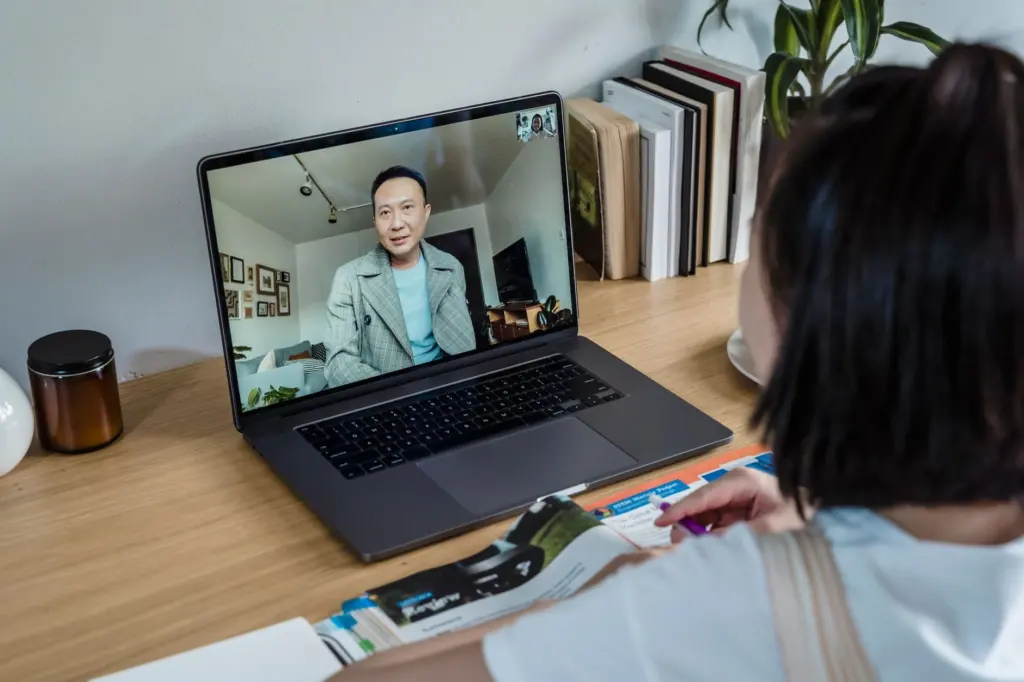
A virtual career fair keeps the same purpose as an in-person one, which Ohio State describes as meeting face to face with recruiters, but the meeting happens on screen. The preparation is largely the same: research, pitch, resume and follow-up all still apply.
Platforms differ, so learn yours before the day. UIC, for example, points students to a Handshake guide to attending a virtual fair and asks them to check its resources before the virtual career fairs. Your school’s career office will usually name the platform and link its help pages.

- Test your setup: check camera, microphone and connection before your first conversation, and sit in a quiet, well-lit spot.
- Keep materials ready: have your resume as a file and your pitch script open on screen, but speak to the camera rather than reading.
- Dress the same way: business attire still applies on camera.
- Follow up the same way: the email template above works unchanged.
Troubleshooting common problems
- Long lines at your top choice: visit a lower-priority employer first to warm up, then return. Arriving early reduces this problem in the first place.
- Your mind goes blank: fall back on your four-part script. Starting with your name and field is enough to get the conversation moving.
- Running out of time at a booth: with only 3-5 minutes available, ask your single best question first and leave the rest for the follow-up email.
- No obvious role for your background: ask what the employer looks for in candidates like you instead of asking what positions exist.
- Nerves: rehearsing aloud before the fair is the most practical fix, since the script then feels familiar.
Frequently asked questions
How much time should I budget for a career fair?
Ohio State suggests ideally 1-2 hours for the entire event. Use that time on your shortlisted employers rather than trying to cover every booth.
Can I contact a recruiter again months later?
Yes. Ohio State says it is fine to check in periodically, every 4-6 months, with recruiters you have already met.
Is business casual enough for a career fair?
Not by the guidance here. Ohio State and UIC both point to business attire, and Ohio State says casual wear should not be worn. Check your own fair’s instructions before choosing a looser outfit.
Is a virtual career fair different from an in-person one?
The conversations happen online rather than at an employer booth, so add a technology check to your preparation. Your pitch, research and follow-up stay the same.